

Is Marvel suffering from superhero fatigue?
An analysis on the concept of 'superhero fatigue,' examining Marvel's content across streaming over the past few years.


In today’s analysis I wanted to take a deep dive into ‘superhero fatigue’.
First, it is important to note that the early Disney-Marvel series premiered during the COVID-19 pandemic, a period when consumer viewing habits shifted dramatically. Streaming consumption surged amid pandemic-related uncertainty, as audiences spent significantly more time at home.
Additionally, it is important to address the issue of content oversaturation. Traditionally, entertainment properties attempt to establish market penetration—through box office success, streaming performance, and positive audience reception—before expanding upon that foundation. However, when an IP reaches a certain level of popularity, studios often accelerate the production of connected or licensed content to capitalize on demand. While this strategy can strengthen brand awareness in the short term, excessive output can eventually contribute to audience fatigue, as consumers begin to perceive the franchise as oversaturated within the entertainment landscape.
But rather than rely on social media discourse or anecdotal sentiment, I wanted to see whether streaming data actually supports the broader narrative that there is ‘superhero fatigue.’
Nielsen vs. Internal-Reporting
In this analysis we are examining Nielsen’s Top Ten rankings from 2023 to early 2026. These totals only reflect weeks in which content appeared in Nielsen’s Top Ten rankings. In other words, this is not total lifetime streaming viewership, but rather measurable engagement during periods where a title ranked highly enough to be reported.
This analysis compares performance across third-party measurement firm Nielsen, while also contrasting those figures with company self-reported metrics.
Few franchises have reshaped blockbuster entertainment like the Marvel Cinematic Universe, which successfully built an interconnected narrative across dozens of films and streaming series over nearly two decades.
Here at StreamScoop, we have collected Nielsen’s Top Ten rankings since the beginning of 2023 until early 2026. I also reviewed select 2021–2022 data to pick out relevant metrics for Marvel’s foray into original series.
Phase Four in streaming
To understand whether audience interest has declined, we first need a baseline. Marvel’s earliest Disney+ releases provide a useful starting point because they arrived during the platform’s most explosive growth period.
As you can see from the graphic below, Disney saw a ton of early success with their original Marvel series. With WandaVision, The Falcon and the Winter Soldier, and Loki all releasing during the uncertainty of the COVID pandemic, these series were able to attain the highest viewership. Part of this early success coincided with pandemic-era viewing habits, when streaming consumption surged amid COVID-19 uncertainty and audiences spent more time at home.
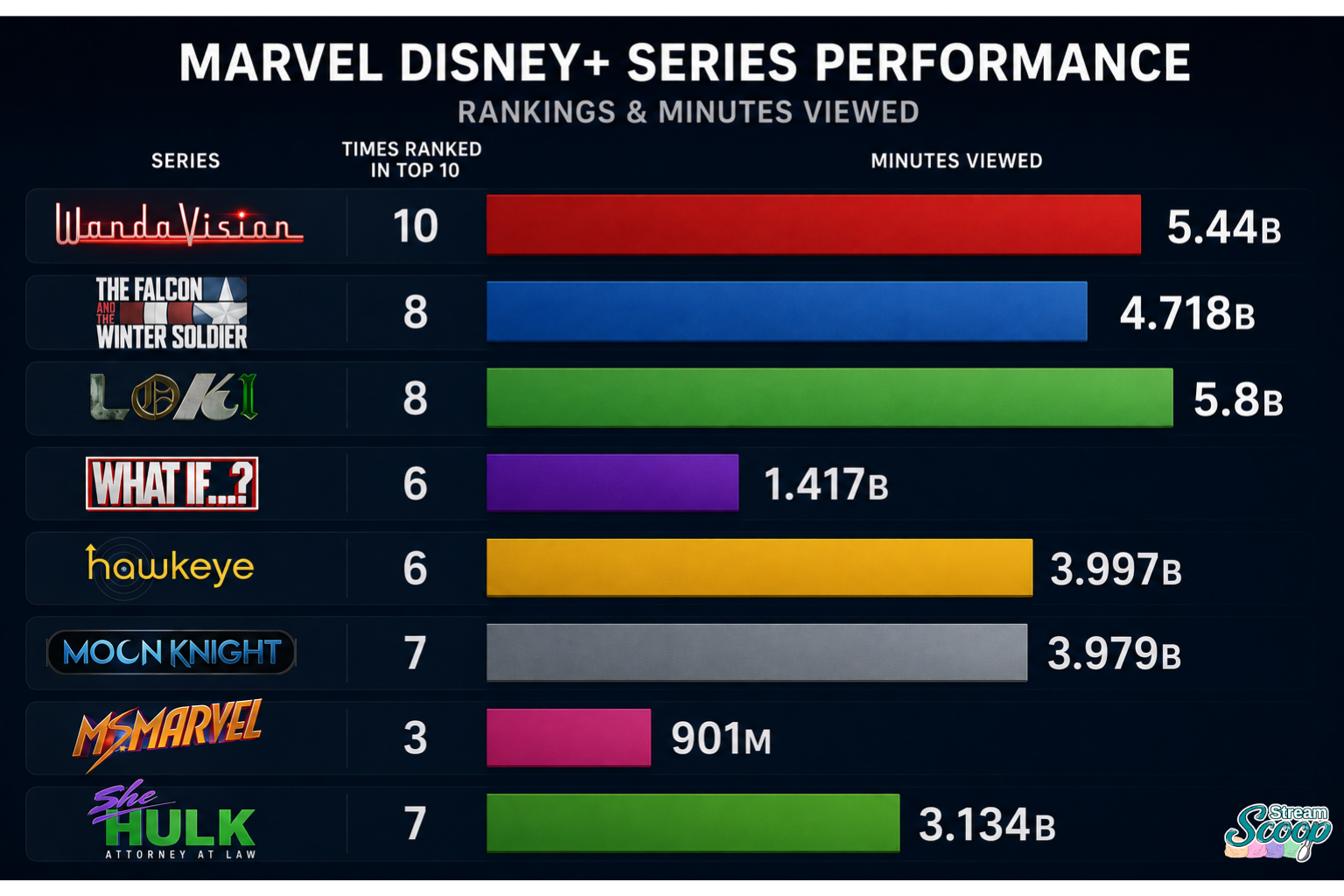
Phase Four projects averaged about 3.67B minutes viewed per series, with the shows averaging 534.29M minutes viewed per week.
Notably, first-season releases of Loki and WandaVision remain Disney’s highest-performing Marvel series, with later entries generally trending downward. Notably, even Hawkeye and Moon Knight outperformed subsequent Phase Five Disney+ Marvel original programming in total minutes viewed.
However, early success alone does not tell us much about long-term audience interest. If superhero fatigue is real—or if Marvel oversaturation has become a factor—we would expect to see some softening in engagement as Disney+ expanded its Marvel slate. That brings us to Phase Five.
Phase Five in streaming
The general sentiment on Marvel’s Phase Four original series was fairly positive, with some series faring better than others. But we see some criticism and thematic-uncertainty carry into the next phase of Marvel original content.
While Loki Season 2 still earns a massive audience, it’s worth noting that Nielsen’s measurement doesn’t differentiate between seasons, so some of these minutes viewed can be attributed to people finding and watching Season 1 alongside Season 2 viewers.
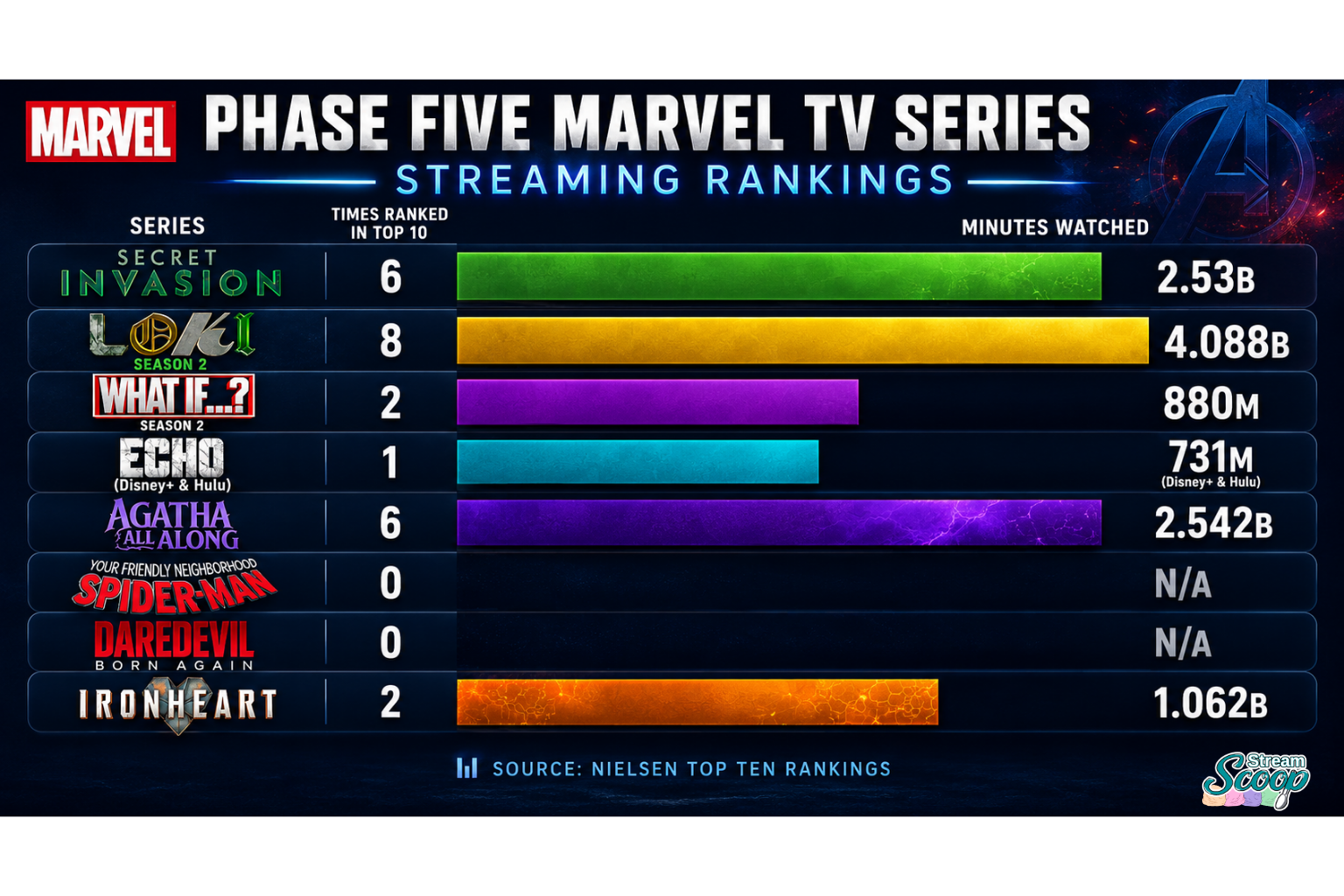
Including Your Friendly Neighborhood Spider-Man and Daredevil: Born Again—which failed to appear in Nielsen’s Top Ten—Phase Five projects averaged roughly 1.48B minutes viewed per series, representing a massive 59% decline from Phase Four averages. The data highlights a major declining interest in Marvel’s Disney+ original series. That decline is notable, though it is worth remembering that Phase Four benefited from pandemic-era viewing patterns and fewer competing Marvel releases.
Echo’s 731M minutes viewed came behind a substantial marketing campaign alongside a dual release on both Disney+ and Hulu, and even then, the series only ranked once.
That said, Nielsen rankings only tell part of the story. Because third-party measurement can miss nuances in viewer behavior, it’s worth comparing these findings with Disney’s own internal reporting to see whether a different picture emerges.
Disney Self-Reported Viewership Rankings
Loki Season 2: 3.63M viewers per day (first three days) - press release
Daredevil: Born Again: 1.5M viewers per day (first five days) - report
Agatha All Along: 1.33M viewers per day (first week) - report
X-Men ‘97: 800K viewers per day (first five days) - report
Nielsen’s data showcases a drastically different ranking of the top three live-action series here. While Loki Season 2 is still the largest, Disney’s self-reported data highlights that Daredevil: Born Again outperformed Agatha All Along in early engagement. Nielsen data doesn’t even showcase Daredevil’s series ranking for its premiere, where the lowest threshold for the week was only 344M minutes viewed.
The gap between Disney’s internal reporting and Nielsen’s third-party data shows how streaming success can be framed two very different ways. Disney’s self-reported figures typically highlight early engagement windows — the first three to five days after premiere — capturing the most enthusiastic segment of the audience. Nielsen, by contrast, measures total minutes viewed across a title that week, rewarding sustained viewership through the week and over time. Daredevil: Born Again illustrates this most sharply: Disney’s self-reported data ranked it second among Phase Five series, yet it never cracked Nielsen’s Top Ten during its premiere week.
Phase Five & Six movies in streaming
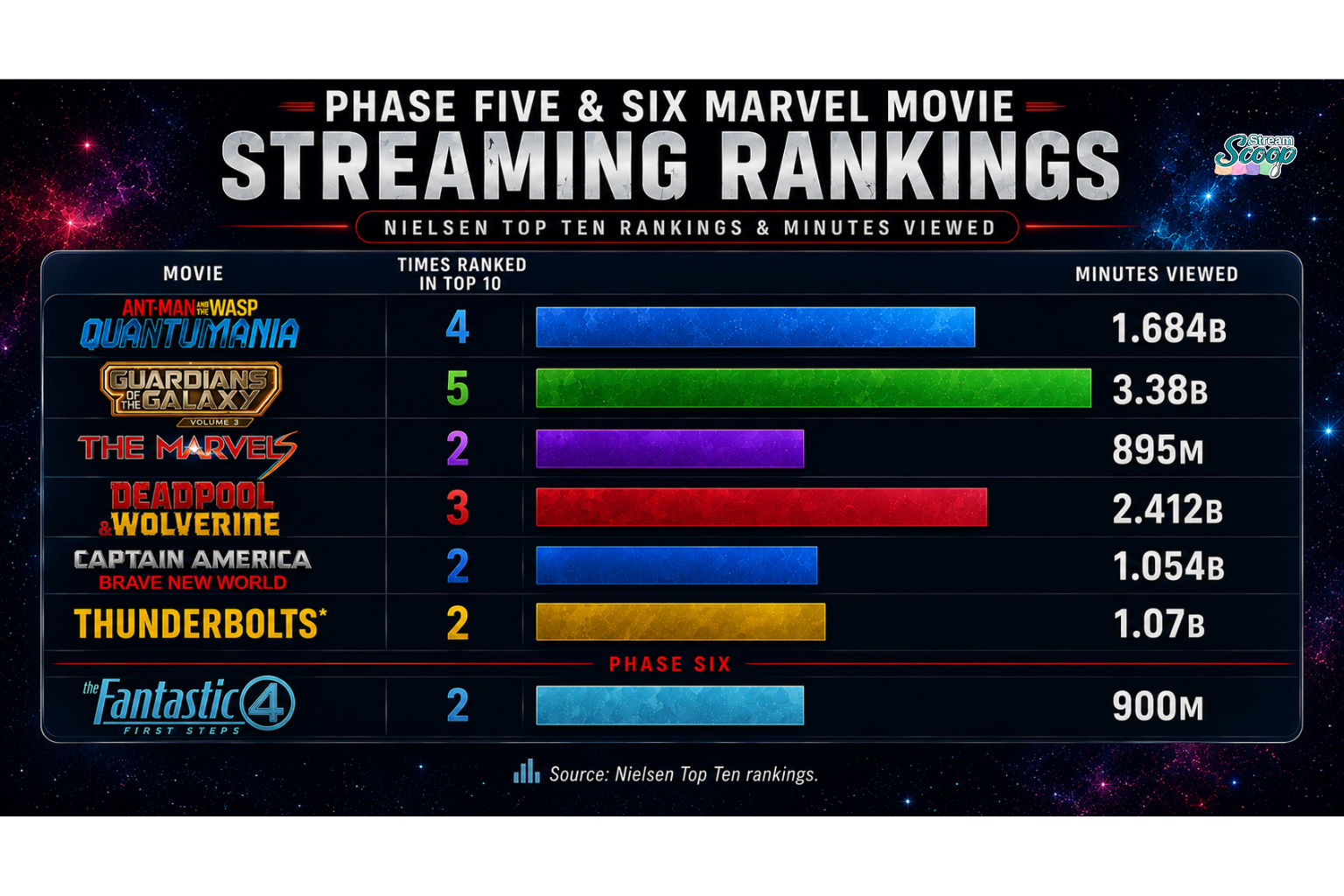
As mentioned, our data goes back to the beginning of 2023, so this chart just showcases the streaming insights for content from the past three years.
Among the Phase Five and Phase Six movies, the top critically received projects earned the highest viewership. Guardians of the Galaxy 3 (94% on Rotten Tomatoes) and Deadpool and Wolverine (94% on Rotten Tomatoes) made up over 50% of the minutes-viewed among these projects with about 5.8B minutes viewed.
This doesn’t necessarily mean that MCU movies are “dead” by any means though, as movies generally don’t earn the minutes-viewed that acquired content and original series do, due to the catalog of episodes offered and accumulative run time varying between series.
If superhero fatigue exists, the streaming data offers a preview rather than a verdict. The decline between Phase Four and Phase Five is real and significant, but it's entangled with too many variables — pandemic-era viewing inflation, content volume, episode runtimes, and measurement gaps — to be read as a clean signal. What's clearer is that Marvel's margin for error has shrunk. Early in the Disney+ era, even mid-tier releases drew enormous audiences on brand recognition alone. That cushion appears to be gone.
Check out our latest articles!
Sports Streaming Guide: the NBA Finals & NHL Stanley Cup, and more!
Streaming this Week: Clarkson’s Farm S5, Hoppers, and more!
Data Dump: Dutton Ranch earns 12.9M viewers for premiere, and more!

Thanks for reading! Make sure to tune in later this week for our Data Dump article, rounding up broadcasting and streaming viewership from the past week!
!!
Man I liked Daredevil: Born Again, why didnt it rank?